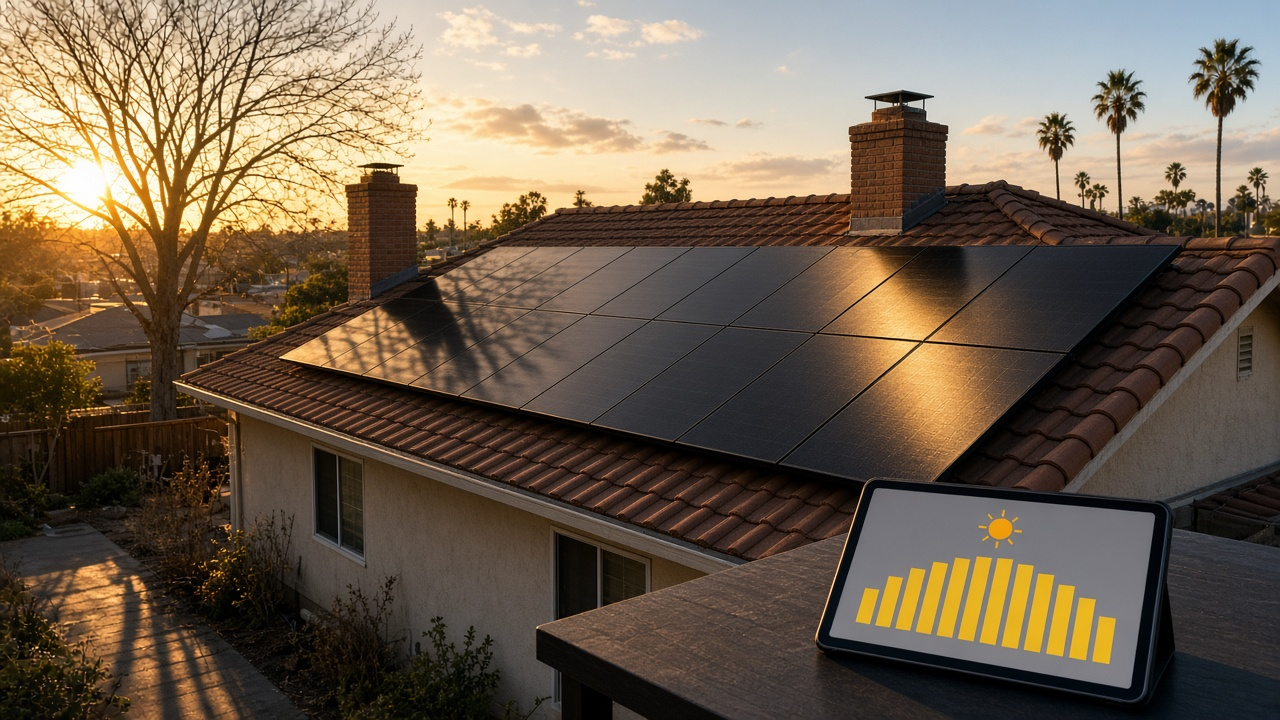
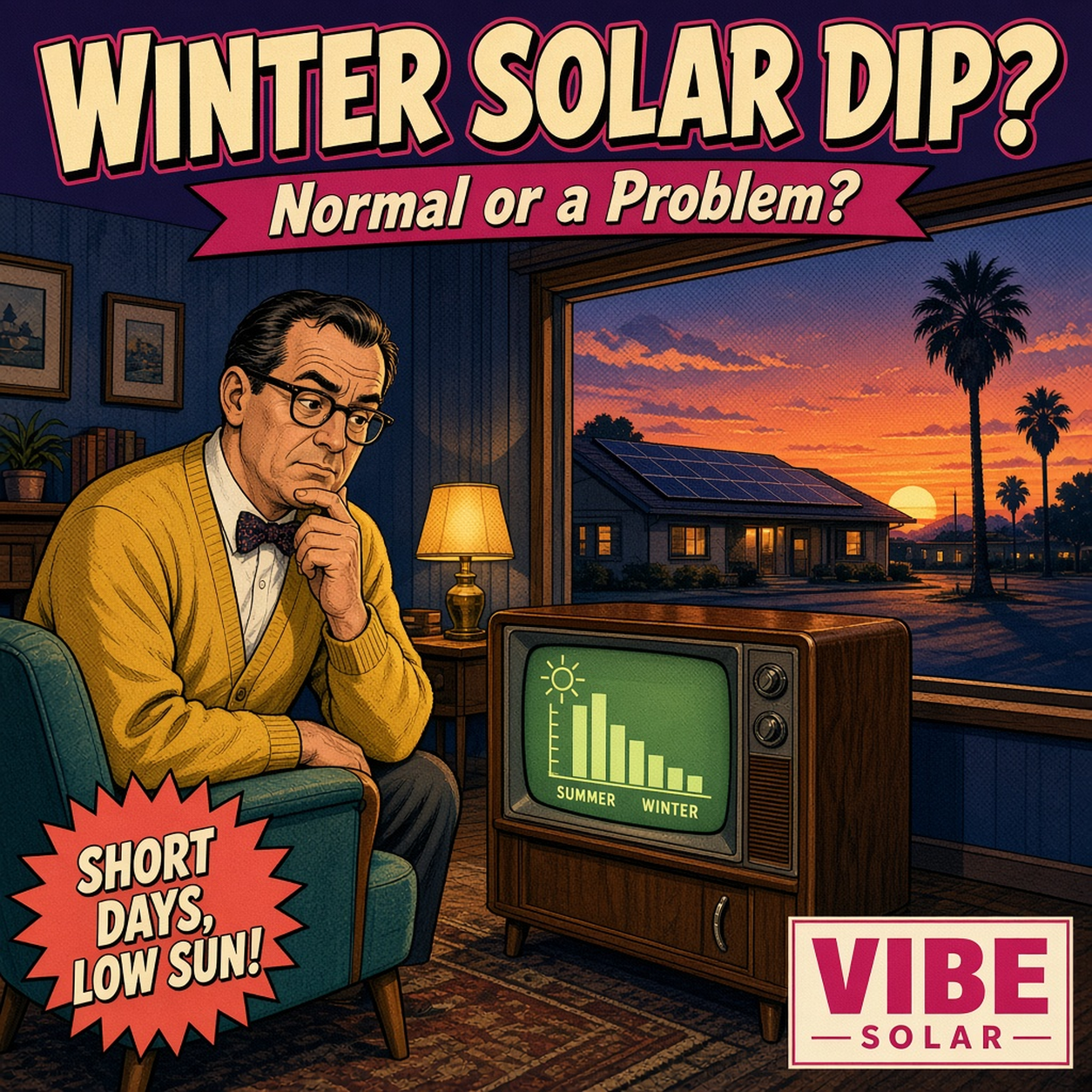
Opened your solar app lately and wondered why the numbers look smaller? You’re not imagining it. Your solar produces less in winter, and for most California homes that dip is completely normal. Clocks fell back on November 1, and the days keep getting shorter until the winter solstice on December 21.
Whether you’re in Bakersfield, the Antelope Valley, Los Angeles, or San Diego, and whether you’re with SCE, LADWP, SDG&E, or PG&E, here’s what’s behind the winter slowdown, how big a normal dip really is, and how to tell when lower numbers point to an actual problem.
Why Solar Produces Less in Winter
Three things work together to lower winter output:
- Shorter days. According to timeanddate.com’s Los Angeles sun tables, sunset is 4:54 p.m. on November 7, and the earliest sunset of the year arrives around December 4 and 5 at 4:43 p.m. The winter solstice in L.A. has about 9 hours and 53 minutes of daylight, roughly 4.5 hours less than the June solstice.
- A lower sun. At midday on the June solstice, the sun sits about 79 degrees above the horizon in Los Angeles. On December 21, it peaks around 32 degrees. Lower-angle sunlight delivers less energy to your panels, even on a clear day.
- Seasonal shading. A low winter sun casts longer shadows. A tree, chimney, or neighbor’s second story that never touched your panels in July can shade part of your array in December.
Cloudy and stormy days lower output further.
How Big Is a Normal Winter Dip?
We ran a typical home system through PVWatts, the free solar calculator from the National Laboratory of the Rockies (formerly NREL). For a 6 kW, south-facing roof system tilted 20 degrees, using typical-year weather, the model estimates:
- Los Angeles: about 600 kWh in December versus about 976 kWh in June
- San Diego: about 644 kWh in December versus about 968 kWh in June
- Bakersfield: about 579 kWh in December versus about 1,064 kWh in June
In other words, a healthy system in these cities can make roughly a third to nearly half less in December than in June. Your roof direction, tilt, shade, and the weather in a given year will change your exact numbers, but a drop in that range is normal.
Normal Dip or Real Problem? How to Check
A seasonal dip is gradual, then reverses as days lengthen after the solstice. A problem usually looks different:
- Compare the same month, year over year. Compare this December with last December, not with July.
- Look at panel-level data. If you have Enphase microinverters, the Array tab in the Enphase App shows production for each panel. A gradual seasonal dip lowers all panels together. One or two panels lagging well behind their neighbors can point to shade, soiling, or an equipment issue.
- Watch for zero days. Zero production on a clear, sunny day is never a normal winter dip. It can mean a tripped breaker, an inverter fault, or a system that is off.
- Separate sudden drops from slow ones. A sharp drop between similar sunny days deserves a look. A steady slide across weeks is the season.
- Check whether the system is reporting. A gap in your app may be a monitoring problem, such as Wi-Fi changes or a communication glitch, rather than a production problem. Enphase says a microinverter that is not reporting can often resolve on its own, but if it lasts more than 24 hours, it is worth troubleshooting.
If you’re also seeing dust or debris on your panels, our Fall Solar Checkup guide covers cleaning and storm prep.
Where Your Battery Fits in Winter
Shorter days mean less extra solar to store, so it helps to know how your battery is set up. Many California time-of-use plans, including SCE’s TOU-D-4-9PM, PG&E’s E-TOU-C, and SDG&E’s TOU-DR1, charge the most from 4 to 9 p.m. LADWP’s time-of-use plan uses different hours, so check your own plan.
- Evening coverage: In winter, the sun is down before 5 p.m. A battery set to power your home during the evening peak can cover some of those hours, depending on its size, how full it gets during the day, and how much power you use.
- Backup reserve tradeoff: A higher reserve keeps more energy ready for outages, while a lower one leaves more for everyday evening use. The right setting depends on your household and how much backup you need.
Battery results vary from home to home, and the right setting is a choice, not a guarantee of savings.
Look at Your Whole Year, Not Just December
Solar is designed around a full year of production. Long summer days typically produce more, and short winter days produce less. If your utility bills solar customers on an annual true-up or 12-month cycle, the winter months are only part of that picture. Look at your full year of production and usage before deciding something is wrong.
What Solar Can and Can’t Do in Winter
Solar still works in winter. A well-designed system plans for the seasonal low. But solar can’t change how many daylight hours you get, remove shade from a neighbor’s tree, or make December look like June. No installer should promise winter numbers that match summer. If your output stays well below the same month last year, the issue may be equipment, shade, or monitoring, and it’s worth having it checked.
Let Vibe Solar Check Your Winter Numbers
Not sure if your dip is normal? Call us with your year-over-year numbers, and we’ll help you sort out what’s seasonal and what may need a closer look.
Ready to see what solar and battery could do for your home all year?
Vibe Solar serves homeowners from Bakersfield to San Diego. We review your utility bill, rate plan, roof, and backup priorities, then design a system around how your household uses power. Call 661.485.5000 or Click Here to Book Your Free Consultation.
Check out our other blogs HERE.