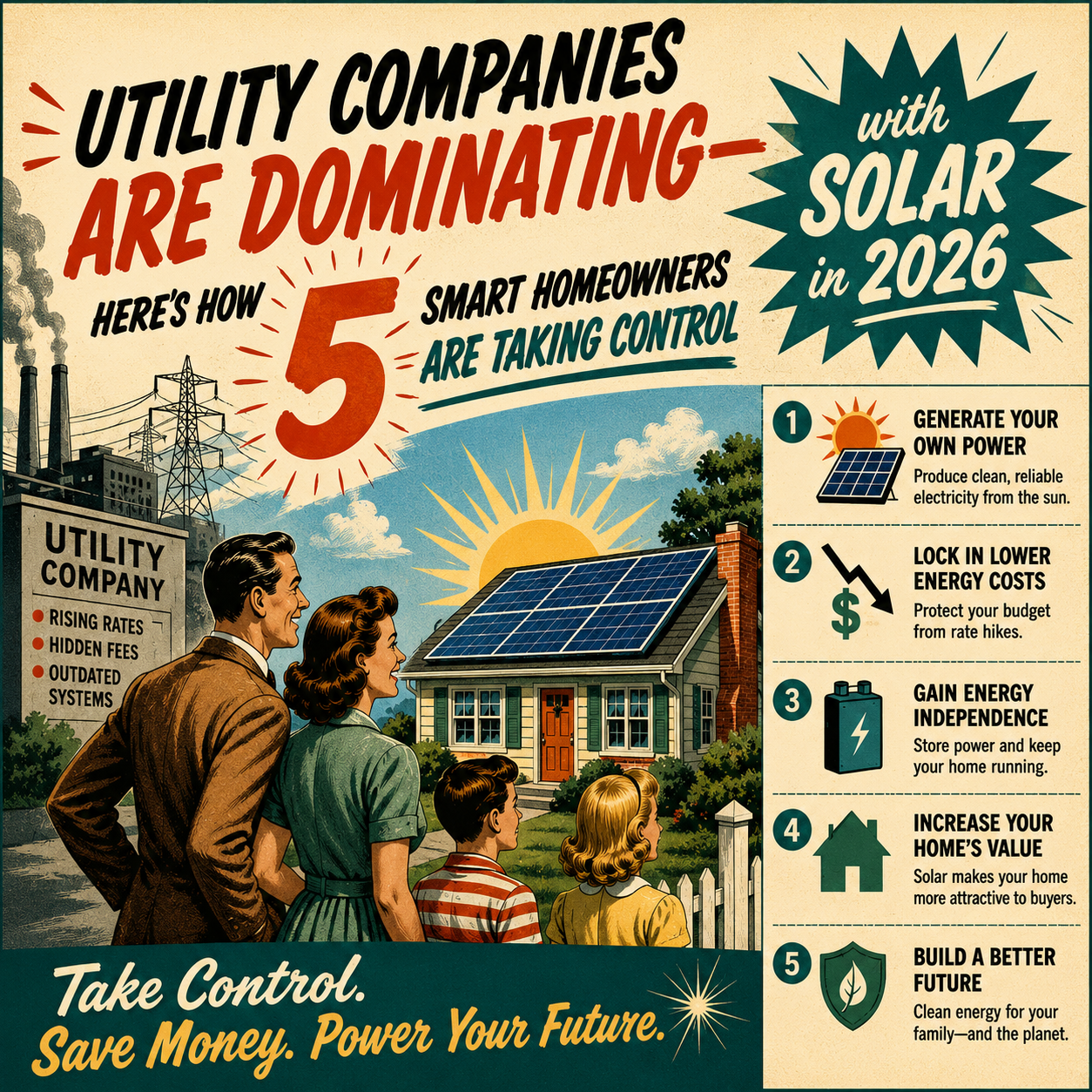
For years, utility companies have had the upper hand. Rates rise, fees increase, and homeowners are left with little control over what they pay each month. But in 2026, a shift is happening—and it’s not subtle.
Some homeowners are staying passive, absorbing every increase without a plan. Others are taking control, changing how their homes operate, and turning energy into a financial advantage. The gap between the two is growing fast.
Here’s how five smart homeowners are pulling ahead—and why standing still could be costing you more than you realize.
1. The Fixed-Bill Strategist vs. The Rate-Hike Victim
One homeowner locks in predictable energy costs, while another watches bills fluctuate month after month.
Utility companies are continuing to raise rates due to infrastructure upgrades and grid demand. Passive homeowners feel every increase. Proactive ones create stability by generating their own power, reducing reliance on unpredictable pricing.
Over time, that difference compounds. One household gains control—while the other keeps paying more.
2. The Equity Builder vs. The Monthly Spender
Some homeowners treat energy as a sunk cost. Others turn it into an investment.
Instead of sending money to a utility company every month, proactive homeowners redirect that spending into something that builds value. Over time, this shift can contribute to higher property appeal and long-term financial positioning.
Meanwhile, passive homeowners continue paying for something they’ll never own.
3. The Energy-Independent Thinker vs. The Grid-Dependent Household
Power outages and grid instability are becoming more common in certain regions. While some homeowners remain fully dependent, others are preparing for reliability.
The difference isn’t just convenience—it’s control. One household is reacting to problems, while the other is prepared for them.
That peace of mind has real value, especially as demand on the grid continues to increase.
4. The Incentive Maximizer vs. The Missed Opportunity
In 2026, there are still financial incentives available for homeowners who act. Tax credits, rebates, and local programs can significantly reduce the cost of upgrading energy systems.
Smart homeowners take advantage of these while they exist.
Passive homeowners often wait too long—missing out entirely or entering the market when incentives are reduced or gone. Timing matters, and those who act early tend to benefit the most.
5. The Future-Focused Planner vs. The Late Adapter
Markets reward those who move early. This applies to energy just as much as it does to investing.
Homeowners who adopt forward-thinking solutions today are positioning themselves ahead of the curve. As energy costs continue to rise and demand grows, these households are already optimized.
Late adopters, on the other hand, often face higher costs, fewer incentives, and more limited options.
Why This Divide Is Growing in 2026
The energy landscape isn’t staying the same. Utility rates are rising, infrastructure is evolving, and demand is increasing. Homeowners are being split into two groups:
- Those who take control
- Those who absorb the consequences
There isn’t much middle ground anymore.
The longer someone waits, the more they risk falling behind—not just in monthly costs, but in overall home efficiency and value.
Taking Control Starts with Awareness
The first step isn’t installation—it’s awareness.
If your energy bills feel unpredictable, if you’ve noticed steady utility increases, or if you haven’t evaluated your home’s energy performance in years, there’s a good chance you’re on the passive side of this divide.
The good news is that shifting from reactive to proactive is still possible.
Final Thoughts
Utility companies aren’t slowing down. Rates will continue to rise, and demand will continue to grow. The question is whether your home adapts—or falls further behind.
The smartest homeowners in 2026 aren’t just giving money away to their utility company, they’re controlling it.
And once you see the difference, it becomes clear: you’re either getting ahead, or you’re quietly losing ground.