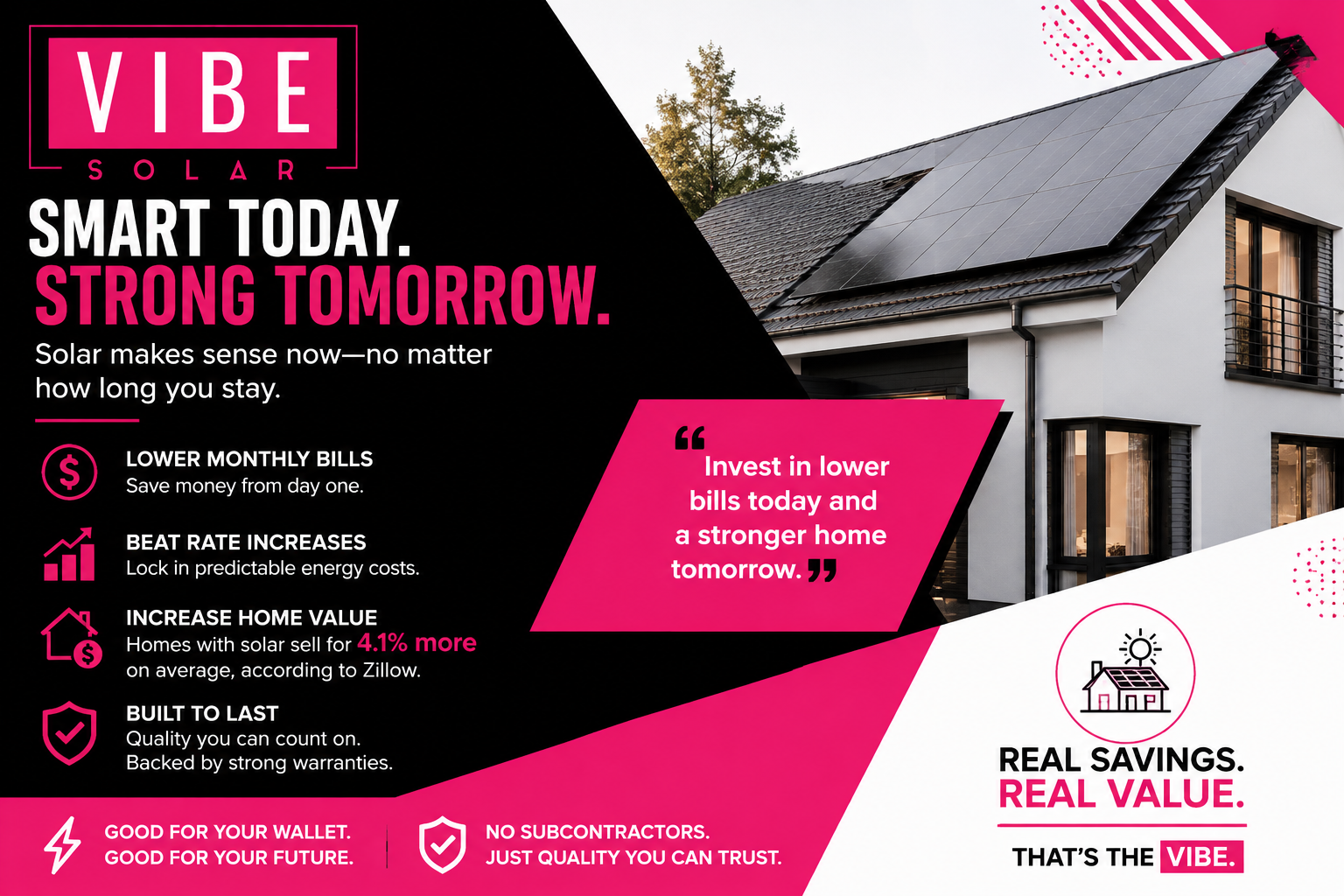

One of the most common questions we hear at Vibe Solar is:
“I’m not sure how long I’ll live here. Does solar still make sense?”
It’s a great question—and one that deserves an honest answer.
The truth is:
It depends. But for many homeowners, the answer is still yes.
Our goal isn’t to convince everyone to install solar. Our goal is to help you determine whether it makes financial sense for your situation.
The Biggest Misconception About Solar
Many people assume that solar only makes sense if they plan to stay in their home for the next 20 or 30 years.
That’s one of the biggest misconceptions about going solar.
The real question isn’t:
“Will I live here forever?”
The better question is:
“How much money will I spend on electricity while I do live here?”
Whether you stay in your home for three years or thirty years, one thing is almost certain—you’ll continue paying an electric bill.
The decision is whether you’d rather continue sending those payments to the utility company, or potentially lower your energy costs while you own the home.
Think About It Like This
Imagine gas prices suddenly dropped by a dollar per gallon.
Would you avoid filling up because you’re planning to buy a different car next year?
Of course not.
You’d enjoy paying less every time you stopped at the pump until the day you sold that vehicle.
Solar works in a similar way.
If it reduces your monthly electricity costs while you own your home, those savings are real—regardless of whether you move a few years later.
The Value Isn’t Just Monthly Savings
When homeowners think about solar, they often focus only on reducing their electric bill.
That’s certainly one benefit.
But it may not be the only one.
Many buyers are willing to pay more for a home that’s already equipped with solar because they understand the value of lower monthly energy costs.
According to a Zillow analysis, homes with solar sold for an average of 4.1% more than comparable homes without solar. While results vary by location and market conditions, the nationwide average suggests that many buyers recognize solar as a valuable home feature.
Here’s what that could look like:
- A $500,000 home could see an average premium of approximately $20,500.
- A $750,000 home could see an average premium of approximately $30,750.
- A $1,000,000 home could see an average premium of approximately $41,000.
Of course, every home sale is different.
Home values are influenced by many factors, including the local real estate market, the age and condition of the solar system, whether the system is owned or financed, and buyer demand at the time of sale. While no one can guarantee a specific increase in value, studies suggest that many buyers place additional value on homes with solar already installed.
Think about it from a buyer’s perspective.
If you’re comparing two nearly identical homes, but one comes with significantly lower monthly utility bills, which one would you rather own?
For many buyers, that’s an easy decision.
What If I Move in a Few Years?
Life changes.
People relocate for work.
Families grow.
Retirement plans change.
Children move away.
Sometimes homeowners stay much longer than expected. Sometimes they move much sooner.
That’s why it’s important to look at the entire financial picture instead of focusing only on how long you’ll own the home.
Potential benefits may include:
- Lower monthly electric bills while you own the home.
- Protection from future utility rate increases.
- Potentially increased home value.
- A home that may appeal to buyers looking for lower energy costs.
The right decision depends on your home’s energy usage, financing, future plans, and local housing market—not simply how many years you expect to stay.
Let’s Look at a Simple Example
Suppose your electric bill averages $350 per month.
If a properly designed solar system reduces your monthly energy costs by $100 to $150 per month, and you stay in your home for five years, that could mean approximately $6,000 to $9,000 in reduced utility costs during that time.
Those numbers are only examples.
Actual savings depend on factors such as:
- Your utility company
- Future electricity rates
- Your energy usage
- System size and production
- Financing terms
- Weather and seasonal consumption
Every homeowner’s situation is different.
The important takeaway is that you don’t necessarily need to stay in your home for decades to experience meaningful financial benefits.
When Solar Might Not Be the Right Choice
At Vibe Solar, we believe honesty builds trust.
There are situations where solar may not be the best financial decision.
If you’re planning to sell your home very soon, your roof isn’t a good fit, or the numbers simply don’t work in your favor, we’d rather tell you that than recommend a system that isn’t in your best interest.
Solar should never be sold through pressure.
It should be recommended because it makes financial sense.
Ask a Better Question
Instead of asking:
“Will I live here long enough?”
Ask yourself:
“Will solar improve my financial situation while I own this home?”
For many homeowners, the answer is yes.
For others, it may not be.
That’s why every home deserves an individualized evaluation instead of a one-size-fits-all answer.
The Bottom Line
Nobody knows exactly how long they’ll stay in a home.
Jobs change.
Families grow.
Life happens.
The goal isn’t to install solar only if you’ll live there forever.
The goal is to make the smartest financial decision for the time you do own the home.
If solar helps lower your monthly energy costs today, protects you from future utility rate increases, and potentially makes your home more attractive to future buyers, it may provide value whether you stay for five years or twenty-five.
At Vibe Solar, we’re here to help you understand the numbers—not pressure you into a decision.
If solar makes financial sense for your home, we’ll show you why.
If it doesn’t, we’ll tell you that too.
Because the best solar decision is an informed one.
Click here to read this Zillow article!