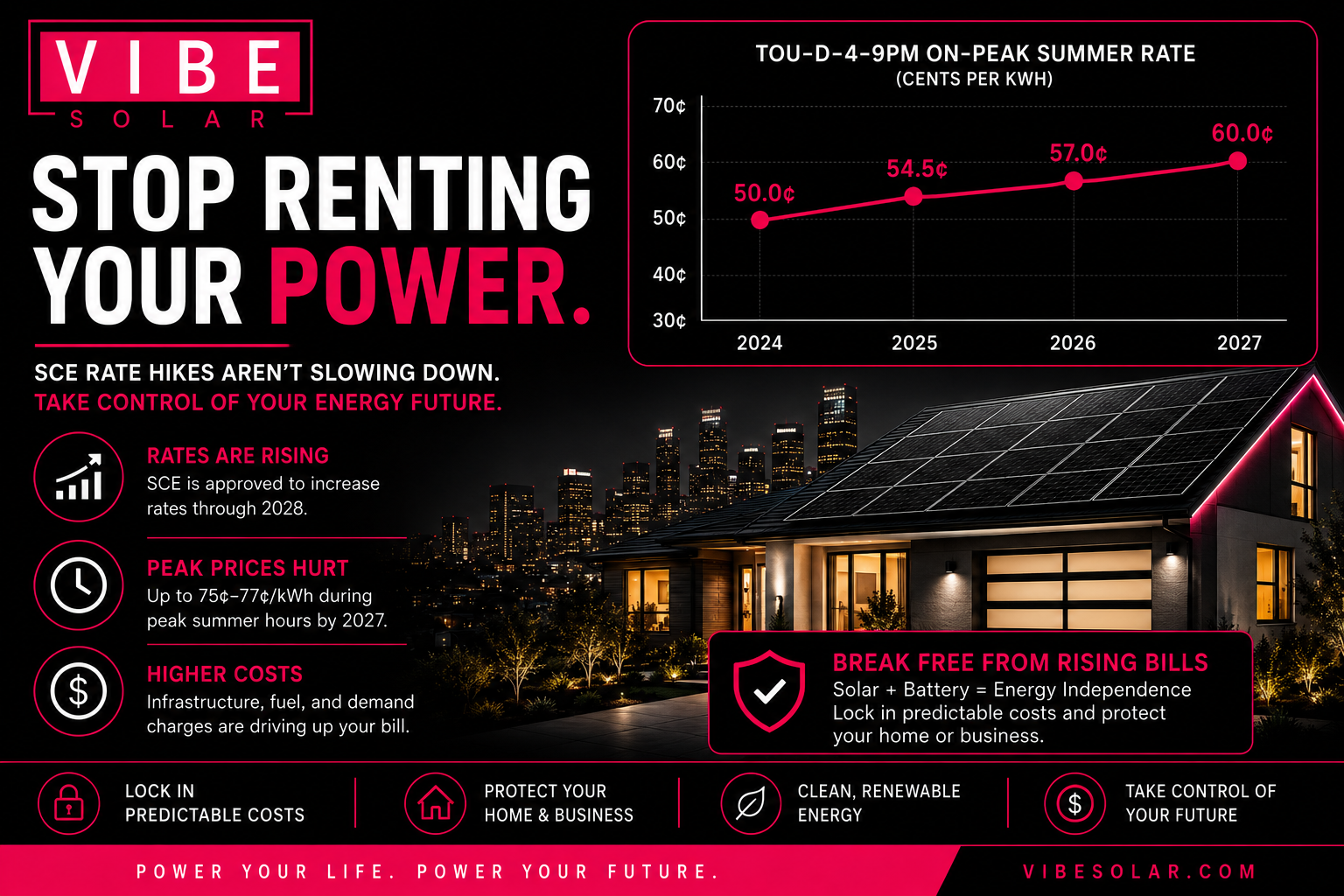

Stop Renting Your Power: Why Southern California Edison’s Rising Rates Make Energy Independence More Valuable Than Ever
If you live or operate a business in Southern California, you’ve probably noticed a familiar pattern: your Southern California Edison (SCE) bill keeps climbing, even if your energy usage hasn’t changed. Rate Hikes are real.
Unfortunately, that trend isn’t slowing down.
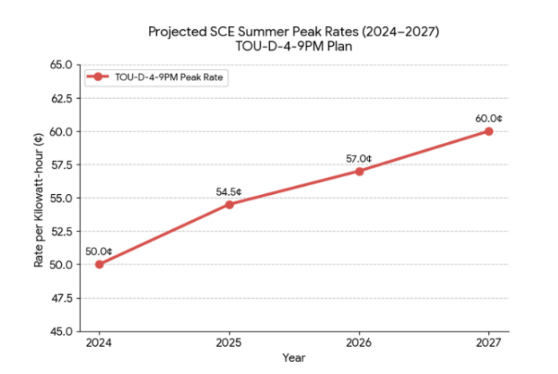
With the California Public Utilities Commission (CPUC) approving SCE’s multi-year General Rate Case (GRC), the utility has authorization to increase revenue requirements through 2028. That means homeowners and business owners should expect continued upward pressure on electricity costs for years to come.
The question isn’t whether rates will increase—it’s how much those increases will cost you over time.
A New Reality for Electricity Costs
Electricity is no longer a predictable household expense. Between infrastructure investments, wildfire mitigation, grid modernization, and fuel costs, Californians are paying more each year to stay connected to the grid.
Customers on Time-of-Use (TOU) plans are feeling the impact the most.
During peak afternoon and evening hours—when air conditioners, appliances, machinery, and commercial operations consume the most electricity—rates hikes continue to rise. By 2027, many customers will be paying historically high premiums during these peak windows, making everyday energy use significantly more expensive.
This isn’t a temporary adjustment. It’s a long-term structural shift in how electricity is priced across California.
The Numbers Behind the Rate Increases
The CPUC has approved a revenue framework that allows SCE to recover approximately $41.78 billion through its General Rate Case period ending in 2028.
That includes:
- Increased annual revenue requirements to support infrastructure and grid investments.
- Continued cost recovery for wildfire mitigation and system upgrades.
- Additional fuel and power procurement expenses through SCE’s Energy Resource Recovery Account (ERRA).
In addition, SCE’s 2027 ERRA filing seeks recovery of approximately $4.35 billion for fuel and wholesale electricity procurement. Because these costs are generally passed through to customers, fluctuations in energy markets can directly affect monthly utility bills.
Consumer advocacy organizations, including the California Public Advocates Office and The Utility Reform Network (TURN), have also raised concerns that electricity costs have been increasing significantly faster than inflation, placing additional financial pressure on California households and businesses.
What This Means for Homeowners
For residential customers, electricity bills now include costs that extend beyond energy usage alone.
Many homeowners now pay a fixed monthly service charge simply to remain connected to the electric grid, before accounting for any electricity consumed.
At the same time, Time-of-Use pricing means that running air conditioning, charging an electric vehicle, or cooking dinner during peak hours can result in substantially higher energy costs than using the same electricity during off-peak periods.
As electricity prices continue to rise, even modest increases in annual rates can translate into thousands of dollars in additional utility expenses over the life of a home.
Businesses Face Even Greater Pressure
Commercial customers often face an additional challenge: demand charges.
Unlike residential billing, many commercial rate schedules include charges based on a facility’s highest level of electricity demand during a billing period. A single afternoon of heavy HVAC use, manufacturing activity, or equipment operation can influence costs for the entire month.
Combined with rising energy rates, these demand charges can erode operating margins and create uncertainty when forecasting expenses.
For many businesses, utility costs have become an increasingly important factor in long-term financial planning.
Why More Californians Are Looking at Solar
As utility rates continue their upward trajectory, many homeowners and businesses are evaluating solar energy as a way to reduce exposure to future rate increases.
Rather than purchasing all of their electricity from the utility, solar systems allow customers to generate a portion of their own energy on-site. When paired with battery storage, solar can also help reduce dependence on expensive peak-hour electricity by storing energy for use when rates are highest.
While every property and energy profile is different, producing electricity locally can provide greater predictability in an environment where utility prices continue to change.
The Cost of Waiting
Every year that electricity rates increase, the cost of relying solely on utility power grows.
Whether you’re a homeowner trying to manage monthly expenses or a business working to control operating costs, delaying an energy strategy may mean paying more for the same amount of electricity year after year.
Solar isn’t simply about reducing today’s utility bill—it’s about creating greater long-term stability in an increasingly unpredictable energy market.
Take Control with Vibe Solar
The utility has already mapped out its revenue plan through 2028.
The question is whether you’ll continue paying whatever future rates are approved—or begin producing more of your own power.
At Vibe Solar, we help homeowners and businesses understand their energy usage, evaluate solar and battery options, and determine whether generating their own electricity makes financial sense.
As utility rates continue to rise, investing in energy independence may become one of the most effective ways to protect yourself from future increases.
The grid isn’t getting cheaper.
Your electricity doesn’t have to keep getting more expensive.